


 Success in the restaurant industry requires far more than strong food and service. Behind nearly every successful restaurant is a carefully planned financial strategy that supports growth, stability, and day-to-day operations. Whether an operator is opening their first location, acquiring an existing concept, upgrading equipment, or expanding into multiple units, access to capital often becomes one of the most important factors determining long-term success.
Restaurants operate in one of the most demanding business environments in the country. Operators face rising labor costs, fluctuating food prices, changing consumer expectations, and increasingly competitive local markets. At the same time, customers expect speed, consistency, technology integration, and memorable experiences. Because of this, financing is no longer viewed simply as a tool to “cover costs.” It has become a strategic component of restaurant growth and operational efficiency.
Many owners underestimate the amount of capital required to operate successfully beyond the initial opening phase. While buildout expenses are significant, restaurants also require ongoing liquidity for payroll, inventory, staffing, marketing, repairs, technology upgrades, and working capital reserves. Even profitable restaurants can experience seasonal fluctuations or unexpected operational expenses that create temporary cash flow pressure.
The good news is that financing options today are far more flexible than they were years ago, giving restaurant owners access to capital solutions tailored to virtually every stage of the business lifecycle.
Financing a New Restaurant Concept
Launching a restaurant from the ground up remains one of the most capital-intensive ventures in small business. Depending on the concept, startup costs may range from under six figures to several million dollars. Fast-casual restaurants, cafés, and food-service franchises often require less upfront investment than high-end dining concepts with extensive buildouts and large kitchens, but nearly all restaurant startups require significant capital planning.
Startup financing is commonly used for:
- Leasehold improvements
- Construction and renovations
- Kitchen and cooking equipment
- Furniture and décor
- POS systems and technology
- Inventory and initial supply purchases
- Staffing and payroll
- Marketing and launch expenses
- Franchise fees and licensing costs
- Working capital reserves
Lenders evaluating restaurant startups generally focus heavily on the operator behind the project. Restaurant experience often carries substantial weight because lenders understand how difficult the industry can be for first-time operators. Borrowers with prior ownership, management, or franchise experience typically present a stronger financing profile.
A detailed business plan is equally important. Strong financial projections, market analysis, and a clear operational strategy help demonstrate that the concept has been thoroughly planned. Liquidity also matters significantly because restaurants often require several months to stabilize revenue after opening.
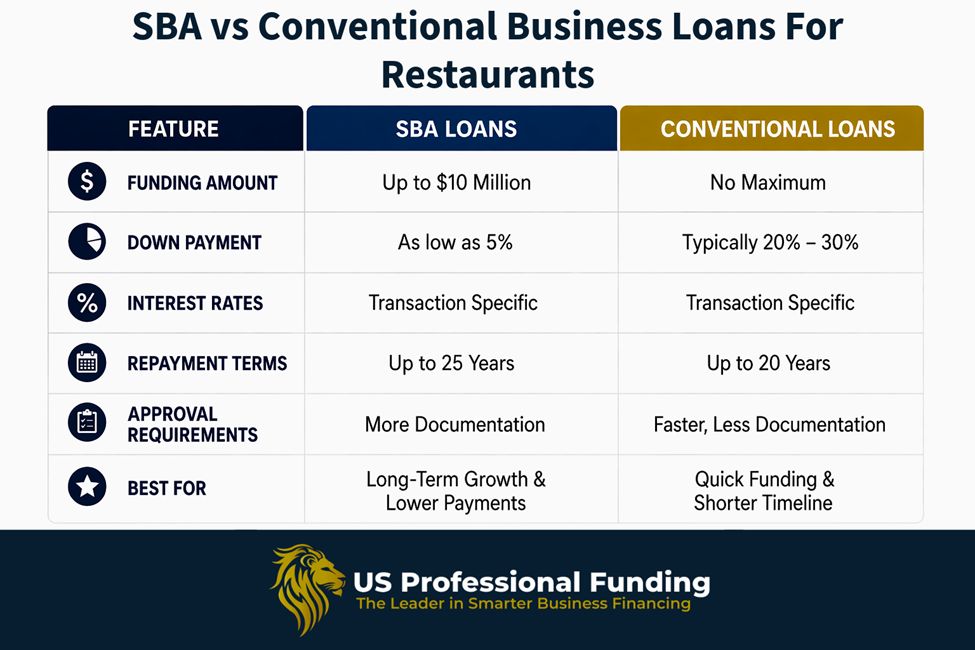
One of the most common financing structures for restaurant startups is SBA financing. Longer repayment terms and lower monthly obligations can help preserve cash flow during the early stages of operation. Conventional financing may also be available for experienced operators with strong financial profiles and sufficient liquidity.
Perhaps the most overlooked area of startup financing is working capital. Many restaurant owners focus almost entirely on construction and equipment costs while underestimating the importance of having adequate reserves available after opening. In reality, having sufficient liquidity during the first year can be one of the biggest factors separating successful restaurants from those that struggle early.
Purchasing an Existing Restaurant
Acquiring an existing restaurant can provide entrepreneurs with advantages that startups often lack. Established restaurants may already have trained staff, operational systems, customer traffic, vendor relationships, equipment, and historical revenue. In many cases, acquiring a profitable operation can reduce some of the uncertainty associated with opening a brand-new concept.
Restaurant acquisition financing may be used for:
- Purchasing independent restaurants
- Franchise acquisitions
- Multi-unit purchases
- Partner buyouts
- Real estate tied to restaurant operations
Unlike startup financing, acquisitions are typically evaluated based on historical business performance. Lenders often review tax returns, profit and loss statements, merchant processing history, bank statements, and overall cash flow trends to determine whether the business generates enough income to support the proposed debt structure.
Restaurants with stable revenue, strong margins, and consistent operating history are usually easier to finance than startups because lenders can evaluate actual business performance instead of relying entirely on projections.
Acquisition financing can also help buyers preserve liquidity rather than deploying all available cash into the purchase itself. Maintaining reserves remains critical in the restaurant industry because operators frequently encounter unexpected expenses ranging from equipment failures to rising food costs or labor shortages.
Restaurant Equipment Financing
Equipment expenses represent one of the largest capital requirements for restaurant owners. Commercial kitchens require substantial investment in cooking equipment, refrigeration, ventilation systems, prep stations, freezers, dishwashing systems, and more. Front-of-house technology and furniture also contribute significantly to overall project costs.
Equipment financing allows restaurant operators to acquire necessary equipment while preserving working capital for operations and growth initiatives.
Restaurant equipment financing is commonly used for:
- Commercial ovens and ranges
- Refrigeration and freezer systems
- Walk-in coolers
- Ice machines
- POS systems and ordering technology
- Furniture and dining equipment
- HVAC systems
- Food trucks and mobile kitchen equipment
Because the equipment itself often serves as collateral, equipment financing can sometimes offer more flexible approval structures compared to unsecured financing options.
Technology investments have also become increasingly important across the restaurant industry. Online ordering systems, delivery integrations, self-service kiosks, kitchen display systems, and mobile payment platforms now play a major role in customer experience and operational efficiency. Financing can help restaurants modernize their systems without creating excessive strain on cash flow.
Expansion Financing for Growing Restaurant Brands
As restaurants become successful, growth opportunities often follow quickly. Some operators open additional locations, expand into new markets, renovate aging stores, add drive-thrus, or increase kitchen production capacity. While expansion creates opportunity, it also requires careful financial planning.
Restaurant expansion financing may support:
- New location openings
- Franchise development
- Store remodels and rebranding
- Outdoor dining additions
- Kitchen expansions
- Real estate acquisitions
- Hiring and staffing growth
Lenders evaluating expansion opportunities typically want to see operational consistency and financial strength at existing locations. Strong revenue trends, profitability, and management stability help demonstrate that the business model can successfully scale.
Multi-unit operators may pursue financing structures specifically designed for portfolio growth. In many cases, preserving liquidity during expansion becomes just as important as funding the expansion itself. Rapid growth without sufficient working capital can place operational stress on even highly successful restaurant groups.
Franchise Restaurant Financing
Franchise restaurants continue to represent a significant portion of the restaurant industry. Franchise systems provide operators with established branding, operational support, marketing infrastructure, and customer recognition. However, franchise ownership still requires substantial upfront investment.
Financing for franchise restaurants may include:
- Franchise fees
- Buildout and construction costs
- Equipment purchases
- Real estate acquisition
- Working capital
- Multi-unit development financing
Lenders are often more comfortable financing established franchise brands because of their operational history and brand recognition. However, approvals still depend heavily on the borrower’s liquidity, experience, credit profile, and overall financial strength.
Certain franchise systems also maintain preferred lending relationships or SBA-preferred financing programs that can help streamline approvals and improve financing efficiency.
Refinancing Existing Restaurant Debt
Refinancing can become an important financial tool for restaurant owners seeking to improve cash flow or restructure existing obligations. Restaurants that initially relied on short-term financing or higher monthly payment structures may later refinance into longer-term solutions with more manageable obligations.
Restaurant refinancing may help operators:
- Reduce monthly payments
- Consolidate existing debt
- Improve cash flow
- Access additional working capital
- Replace higher-cost financing
- Fund renovations or operational upgrades
Cash flow management remains one of the most important aspects of restaurant ownership. Refinancing can create additional financial flexibility while allowing operators to reinvest back into the business.
What Lenders Evaluate in Restaurant Financing
Although every financing request is unique, several factors consistently influence restaurant financing approvals.
Industry Experience
Restaurant ownership and management experience remain highly important because lenders understand the operational complexity of the industry. Experienced operators are generally viewed as lower risk.
Credit Strength
Personal credit often plays a major role in financing approvals, particularly for startups and closely held businesses. Strong credit profiles can improve approval odds and loan terms.
Cash Flow
Existing restaurants are heavily evaluated based on revenue trends and profitability. Startups rely more heavily on projections, liquidity, and borrower strength.
Liquidity
Restaurants frequently encounter fluctuating operating expenses and seasonal changes. Businesses with stronger liquidity reserves are often viewed more favorably.
Location and Market Strength
Restaurants located in strong retail corridors, growing population centers, or high-traffic markets may receive more favorable financing consideration.
Selecting the Right Financing Structure
Not all restaurant financing solutions are designed the same way. Some structures prioritize lower monthly payments and long-term stability, while others focus on faster access to capital or flexibility for growth initiatives.
The ideal financing strategy depends on the restaurant’s stage of growth, operational goals, and overall financial profile.
For example, a startup may prioritize preserving working capital during the first year of operations, while a multi-unit restaurant group may focus on maximizing leverage and scaling efficiently. Financing should support long-term operational stability rather than create unnecessary financial strain.
Final Thoughts
The restaurant industry continues to evolve rapidly, creating both challenges and significant opportunities for operators. Access to capital allows restaurant owners to launch concepts, acquire businesses, modernize operations, expand locations, and strengthen long-term cash flow management.
Whether financing a startup restaurant, purchasing an established operation, upgrading equipment, or scaling into multiple locations, the right financing strategy can help position a business for sustainable long-term growth.
In today’s competitive environment, successful restaurant operators are often those who combine strong operational execution with disciplined financial planning. Financing is no longer simply about funding a project. It is about creating the flexibility and stability needed to adapt, compete, and continue growing in an increasingly dynamic industry.
Author:
Christopher Cornella
VP of Business Development

Restaurant:
USProfessionalFunding.com/industries/restaurants/
USProfessionalFunding.com/industries/restaurants/restaurant-business-real-estate-acquisition/
USProfessionalFunding.com
USMedicalFunding.com